'%3e%3cpath%20d='M8.09023%2019.6947H16.349L14.0199%2032.6762H6.6C4.94315%2032.6762%203.60001%2031.333%203.6%2029.6762V6.6C3.6%204.94315%204.94315%203.6%206.6%203.6H20.7152L8.09023%2019.6947ZM31.3119%203.6C32.9687%203.60012%2034.3119%204.94322%2034.3119%206.6V29.6762C34.3119%2031.333%2032.9687%2032.6761%2031.3119%2032.6762H16.9613L31.0521%2014.7123H22.7934L24.7875%203.6H31.3119Z'%20fill='var(--fill-0,%20%232BE6FF)'/%3e%3c/g%3e%3cpath%20id='Vector%20210'%20d='M7.6%2019.6L20.6%203.6H25.1L23.1%2014.1L31.1%2014.6L17.1%2032.6H14.1L16.1%2019.6H7.6Z'%20fill='none'/%3e%3cpath%20id='Subtract_2'%20d='M8.09023%2019.6947H16.349L14.0199%2032.6762H6.6C4.94315%2032.6762%203.60001%2031.333%203.6%2029.6762V6.6C3.6%204.94315%204.94315%203.6%206.6%203.6H20.7152L8.09023%2019.6947ZM31.3119%203.6C32.9687%203.60012%2034.3119%204.94322%2034.3119%206.6V29.6762C34.3119%2031.333%2032.9687%2032.6761%2031.3119%2032.6762H16.9613L31.0521%2014.7123H22.7934L24.7875%203.6H31.3119Z'%20fill='url(%23paint0_linear_274_1147)'/%3e%3c/g%3e%3cdefs%3e%3cfilter%20id='filter0_f_274_1147'%20x='0'%20y='0'%20width='37.9119'%20height='36.2762'%20filterUnits='userSpaceOnUse'%20color-interpolation-filters='sRGB'%3e%3cfeFlood%20flood-opacity='0'%20result='BackgroundImageFix'/%3e%3cfeBlend%20mode='normal'%20in='SourceGraphic'%20in2='BackgroundImageFix'%20result='shape'/%3e%3cfeGaussianBlur%20stdDeviation='1.8'%20result='effect1_foregroundBlur_274_1147'/%3e%3c/filter%3e%3clinearGradient%20id='paint0_linear_274_1147'%20x1='18.956'%20y1='3.6'%20x2='18.956'%20y2='32.6762'%20gradientUnits='userSpaceOnUse'%3e%3cstop%20stop-color='%232BE6FF'/%3e%3cstop%20offset='1'%20stop-color='%231A8A99'/%3e%3c/linearGradient%3e%3c/defs%3e%3c/svg%3e)
Managing Volatility in Energy Markets
Volatility is no longer an exception in energy markets. It is part of daily operations.
Prices move with renewable generation, demand patterns, weather changes, storage behavior, grid conditions, and market timing. A position that looks reasonable in the morning may need review later in the day. A strong price signal may disappear before the team has time to act. A production forecast may shift close to delivery, changing both exposure and commercial options.
For energy traders, IPPs, BESS operators, EMS platforms, and market-facing energy teams, volatility creates one central requirement: decisions must be made with a forward view.
Forecasting models help provide that view. Not by removing uncertainty, but by making it more visible, structured, and usable before the market window closes.
Volatility is not only a market issue
Market volatility is often discussed as a pricing topic. In practice, it affects the entire operating chain.
A price movement can change a trading decision. A production shift can change imbalance exposure. A load change can affect procurement. A battery dispatch decision can change asset revenue and future flexibility.
This means volatility is not limited to the trading desk. It touches operations, asset management, procurement, dispatch, and risk.
A day-ahead forecast may influence how a team prepares its position before delivery. An intraday forecast may influence whether that position should be adjusted. A solar or load forecast may change the exposure behind the market decision. A battery forecast may decide whether storage should be used now or held for a later window.
The market price is only one part of the picture. The decision depends on how price, generation, demand, and asset constraints move together.
The day-ahead market: planning before exposure forms
Day-ahead markets give teams a structured planning window. They allow market participants to prepare positions based on expected generation, expected demand, and expected prices before delivery.
The main value of forecasting in the day-ahead market is preparation.
A day-ahead price forecast can help teams review expected market levels, identify periods that may require attention, and assess whether the planned position reflects likely conditions. For IPPs, it can help connect expected renewable production with market value. For BESS operators, it can help assess potential charge and discharge windows. For EMS teams, it can help inform procurement and cost-control decisions.
However, day-ahead forecasting should not be treated as a final answer. It is a planning input.
The forecast gives the team an initial view of where exposure may appear, which intervals may require review, and where flexibility may have value. It creates a basis for action before the delivery period begins.
The intraday market: adjusting as reality changes
Intraday markets exist because conditions change after day-ahead positions are formed.
Solar production may differ from the earlier forecast. Demand may move above or below expectation. Prices may shift as new information enters the market. Battery availability may change. Portfolio exposure may increase or decrease.
Intraday forecasting supports adjustment.
This is where timing becomes critical. The value of an intraday forecast depends on whether it arrives early enough for the team to act. A signal that appears after liquidity has moved or the operational window has closed has limited value.
An intraday market forecast should help answer practical questions:
Is the current position still aligned with expected conditions?
Has price exposure changed enough to review the position?
Is there an opportunity to improve dispatch timing?
Is a production or consumption deviation likely to affect imbalance exposure?
Should the team act now, monitor, or wait for a clearer signal?
This is where forecasting becomes part of active market management.
Price spikes: when timing defines value
Price spikes can create opportunity, exposure, or both.
For a trader, a spike may require position review. For a BESS operator, it may create a dispatch opportunity. For an energy buyer, it may increase procurement risk. For an IPP, it may change the value of expected production.
A forecasting model can help teams identify potential spike conditions earlier. The forecast does not need to guarantee that a spike will occur. It needs to show whether the risk is material enough to review the decision.
This distinction matters.
If every possible price movement triggers action, the team gets noise. If the system only shows the strongest signals, the team can focus on the intervals that deserve attention.
A useful spike forecast should show timing, expected intensity, confidence, and relevance to the portfolio or asset. Without that context, the signal may be too broad to support action.
Negative prices: when generation becomes exposure
Negative prices create a different kind of challenge.
They can appear when generation is high, demand is low, or flexibility is limited. For renewable producers, storage operators, and market participants, negative price periods can affect production value, curtailment decisions, battery strategy, and trading exposure.
Forecasting models can support negative price preparation by identifying periods where price risk may move below commercially acceptable levels.
The decision may then involve several options. A producer may review curtailment exposure. A BESS operator may assess whether charging is attractive. A trader may review the position. An EMS platform may evaluate whether flexible demand can be shifted into the period.
Again, the value is not the forecast alone. It is the response the forecast makes possible.
Imbalance exposure: where volatility becomes cost
Imbalance exposure often appears when expected generation or consumption diverges from actual delivery.
This is especially important for renewable producers, storage operators, aggregators, and market participants managing variable portfolios.
Forecasting helps by identifying where deviation may occur before it becomes financially difficult to control. A solar forecast may show that production is likely to fall below the plan. A load forecast may show that demand is moving above expectation. A market forecast may show that the cost of correction is becoming less favorable.
Imbalance management depends on three things: visibility, timing, and response options.
Visibility shows where exposure may appear. Timing determines whether action is still possible. Response options define what the team can do.
Forecasting models support the first two. The operating workflow must define the third.
Battery dispatch: using volatility without losing control
Battery storage can benefit from volatility, but only when dispatch decisions are disciplined.
A BESS operator needs to know when to charge, discharge, or hold capacity. Volatile markets can create attractive windows, but they can also create false signals. Acting too early, too late, or too often can reduce value and increase asset stress.
Forecasting models can support battery dispatch by connecting expected prices with expected load, renewable generation, asset state, and operational constraints.
A price forecast may show a potential discharge window. But the decision still depends on whether the battery is available, whether the expected spread is strong enough, whether a later window may be more valuable, and whether dispatch aligns with asset strategy.
In volatile markets, the strongest dispatch decisions are not based on price alone. They are based on price in context.
Forecast confidence matters more during volatility
When markets are stable, a forecast can be useful even with limited uncertainty detail. During volatile periods, confidence becomes much more important.
Teams need to know whether the forecast is showing a clear signal or a weak one. They need to understand whether a price movement, production shift, or load change is likely enough to justify action.
This is why ranges, confidence levels, and thresholds matter.
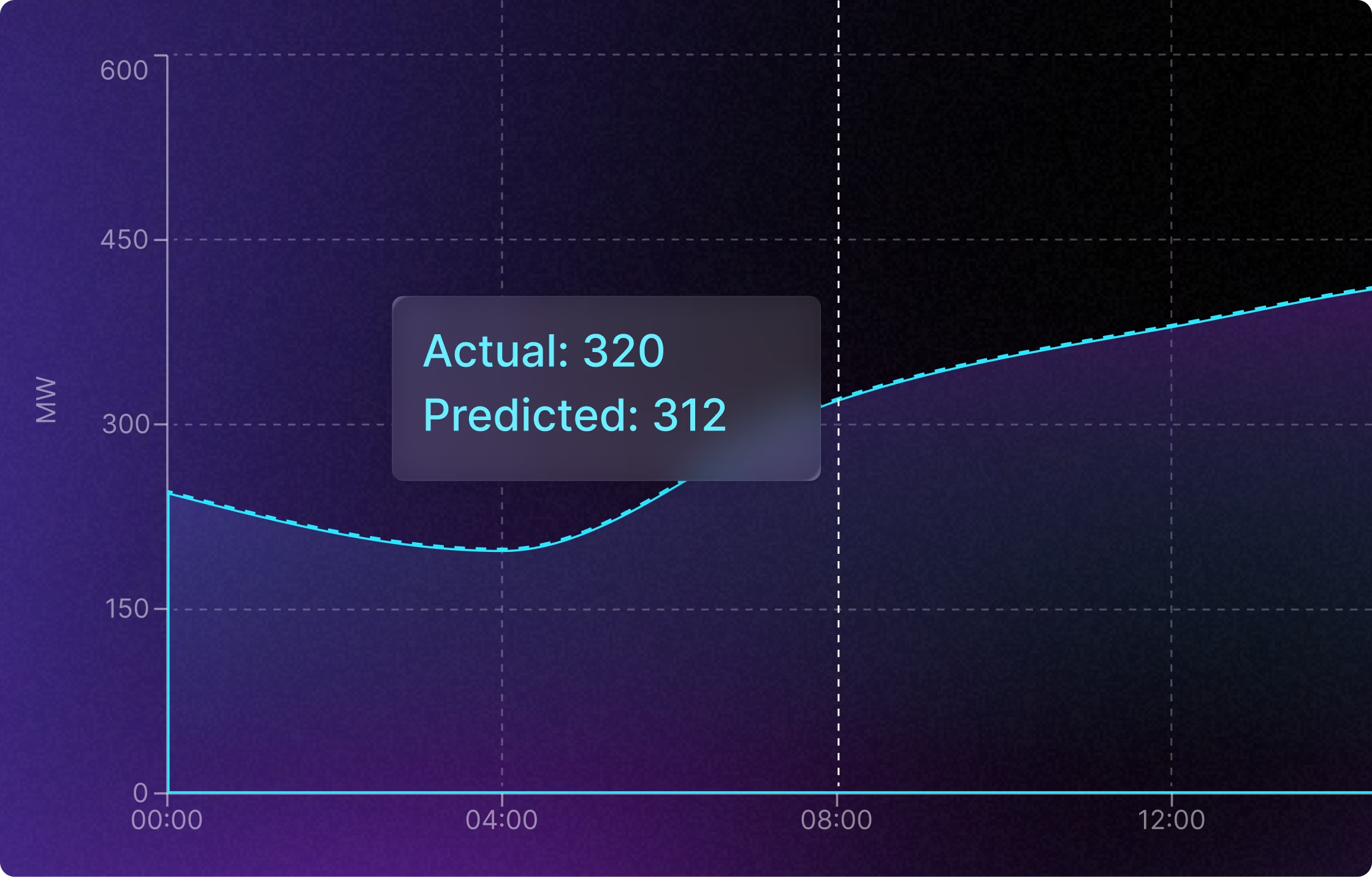
A forecast that says “price may rise” is not enough. A decision-ready forecast should show which interval is affected, how material the movement may be, and whether the signal is strong enough to trigger review.
The same applies to solar, load, and battery workflows. The team needs to know whether a change is normal variance or a material risk.
Volatility requires connected forecasts
Energy market volatility cannot be managed through price forecasts alone.
A market participant may need to connect market price forecasts with solar generation forecasts, load forecasts, and battery availability. An EMS platform may need to connect expected demand with price movement. A BESS operator may need to connect renewable production, market prices, and asset state.
This is because market performance is shaped by interaction.
A price signal may look attractive until load exposure changes. A battery dispatch window may look strong until solar production shifts. A trading position may look stable until the underlying portfolio deviates from expectations.
Connected forecasts help teams see the full decision context rather than one isolated signal.
What forecasting changes in day-ahead workflows
In day-ahead workflows, forecasting improves preparation.
It helps teams identify which intervals require review, where market exposure may develop, and how expected generation or demand may affect the planned position.
For IPPs, this can support production-linked trading decisions. For EMS platforms, it can support procurement and cost planning. For BESS operators, it can support the first view of dispatch opportunities. For traders, it can support position planning before the market closes.
The day-ahead forecast gives teams a structured starting point.
It helps them enter the delivery period with clearer expectations and fewer blind spots.
What forecasting changes in intraday workflows
In intraday workflows, forecasting improves adaptation.
The market is no longer working with only the day-ahead view. It is responding to updated conditions. The team needs to decide whether to maintain the original position, adjust it, or prepare for a different operating outcome.
Forecasting models can help by showing what changed, where it changed, and whether that change is material.
An intraday forecast should not simply repeat the day-ahead forecast. It should show how the outlook has evolved and what that means for the decision now.
This is especially relevant for solar variability, load changes, battery dispatch, price spikes, negative prices, and imbalance exposure.
The role of alerts in volatile markets
Alerts are useful only when they are selective.
In volatile markets, a system can detect many movements. But if every movement becomes an alert, the team stops trusting the signal.
Forecasting alerts should be tied to decision thresholds.
A price spike alert should appear when the expected movement is material enough to review. A negative price alert should appear when exposure may require action. A load alert should appear when demand moves toward an operational or cost threshold. A solar deviation alert should appear when production changes enough to affect scheduling, balancing, or market assumptions.
Good alerts reduce noise. They direct attention to the moments that matter.
Why forecasting performance should be measured by decisions
Forecasting performance is often discussed in terms of model accuracy. Accuracy matters, but it is not the full measure of market value.
In day-ahead and intraday markets, the stronger measure is decision impact. A useful forecast gives the team earlier visibility into exposure, supports more disciplined dispatch timing, reduces unnecessary action, and helps teams review positions before the market window closes.
It can also help teams prepare for price spikes, negative price periods, production deviations, or demand changes while there is still time to respond.
Forecasting should therefore be measured against the decisions it supports, not only the prediction it produces.
Common mistakes in volatile market forecasting
One common mistake is treating the day-ahead forecast as fixed. Market conditions change, so the forecast should be reviewed as new information appears.
Another mistake is acting on every signal. Volatility creates movement, but not every movement deserves action.
A third mistake is looking at price without asset context. Price movement matters only in relation to generation, load, storage availability, exposure, and commercial strategy.
A fourth mistake is ignoring confidence. A forecast with low confidence should not be treated the same as a strong signal.
A fifth mistake is measuring success only by accuracy. The forecast should also be judged by whether it supported timely, measurable decisions.
Volatility in energy markets creates both risk and opportunity.
Forecasting models help teams manage that volatility by giving earlier visibility into price movement, generation shifts, demand changes, imbalance exposure, and dispatch opportunities.
In day-ahead markets, forecasting supports preparation. In intraday markets, it supports adjustment. Across storage, trading, EMS, and IPP workflows, it helps teams decide whether to act, monitor, or wait for a clearer signal.
The real value of forecasting is not that it removes uncertainty. It helps energy teams work with uncertainty before it becomes costly.
Prepare for volatility before the market window closes
Energy market volatility is easier to manage when teams can see changing conditions early enough to respond.
For teams working across day-ahead trading, intraday adjustment, battery dispatch, solar production, or imbalance exposure, it may be useful to review where forecasting could support clearer and more timely market decisions.
Nexenergie can help assess how market, solar, load, and battery forecasts could support decision-making across volatile energy workflows.