'%3e%3cpath%20d='M8.09023%2019.6947H16.349L14.0199%2032.6762H6.6C4.94315%2032.6762%203.60001%2031.333%203.6%2029.6762V6.6C3.6%204.94315%204.94315%203.6%206.6%203.6H20.7152L8.09023%2019.6947ZM31.3119%203.6C32.9687%203.60012%2034.3119%204.94322%2034.3119%206.6V29.6762C34.3119%2031.333%2032.9687%2032.6761%2031.3119%2032.6762H16.9613L31.0521%2014.7123H22.7934L24.7875%203.6H31.3119Z'%20fill='var(--fill-0,%20%232BE6FF)'/%3e%3c/g%3e%3cpath%20id='Vector%20210'%20d='M7.6%2019.6L20.6%203.6H25.1L23.1%2014.1L31.1%2014.6L17.1%2032.6H14.1L16.1%2019.6H7.6Z'%20fill='none'/%3e%3cpath%20id='Subtract_2'%20d='M8.09023%2019.6947H16.349L14.0199%2032.6762H6.6C4.94315%2032.6762%203.60001%2031.333%203.6%2029.6762V6.6C3.6%204.94315%204.94315%203.6%206.6%203.6H20.7152L8.09023%2019.6947ZM31.3119%203.6C32.9687%203.60012%2034.3119%204.94322%2034.3119%206.6V29.6762C34.3119%2031.333%2032.9687%2032.6761%2031.3119%2032.6762H16.9613L31.0521%2014.7123H22.7934L24.7875%203.6H31.3119Z'%20fill='url(%23paint0_linear_274_1147)'/%3e%3c/g%3e%3cdefs%3e%3cfilter%20id='filter0_f_274_1147'%20x='0'%20y='0'%20width='37.9119'%20height='36.2762'%20filterUnits='userSpaceOnUse'%20color-interpolation-filters='sRGB'%3e%3cfeFlood%20flood-opacity='0'%20result='BackgroundImageFix'/%3e%3cfeBlend%20mode='normal'%20in='SourceGraphic'%20in2='BackgroundImageFix'%20result='shape'/%3e%3cfeGaussianBlur%20stdDeviation='1.8'%20result='effect1_foregroundBlur_274_1147'/%3e%3c/filter%3e%3clinearGradient%20id='paint0_linear_274_1147'%20x1='18.956'%20y1='3.6'%20x2='18.956'%20y2='32.6762'%20gradientUnits='userSpaceOnUse'%3e%3cstop%20stop-color='%232BE6FF'/%3e%3cstop%20offset='1'%20stop-color='%231A8A99'/%3e%3c/linearGradient%3e%3c/defs%3e%3c/svg%3e)
Designing Predictive Energy Systems for Modern Energy Forecasting
Predictive energy systems are becoming a core part of modern energy forecasting. As solar generation, load consumption, battery storage, and electricity market prices become more variable, energy operators need forecasting layers that can support decisions before cost, imbalance, or inefficiency materialize.
This need is becoming more urgent as renewable energy grows. The IEA projects that renewables will rise from 32% of global electricity generation in 2024 to 43% by 2030, increasing the importance of forecasting systems that can manage variable generation, demand, storage, and market exposure.
This article examines how predictive energy systems can be designed across three forecasting domains: solar generation forecasting, load consumption forecasting, and market price forecasting. It focuses on the architecture required to turn forecasts into operational signals for EMS platforms, BMS providers, BESS operators, IPPs, OMIE participants, and EPEX market participants.
What are predictive energy systems?
Predictive energy systems are forecasting layers that use historical data, real-time energy signals, weather data, asset data, and market inputs to predict future energy conditions. These systems can forecast solar generation, load consumption, electricity prices, demand peaks, imbalance exposure, and battery dispatch opportunities.
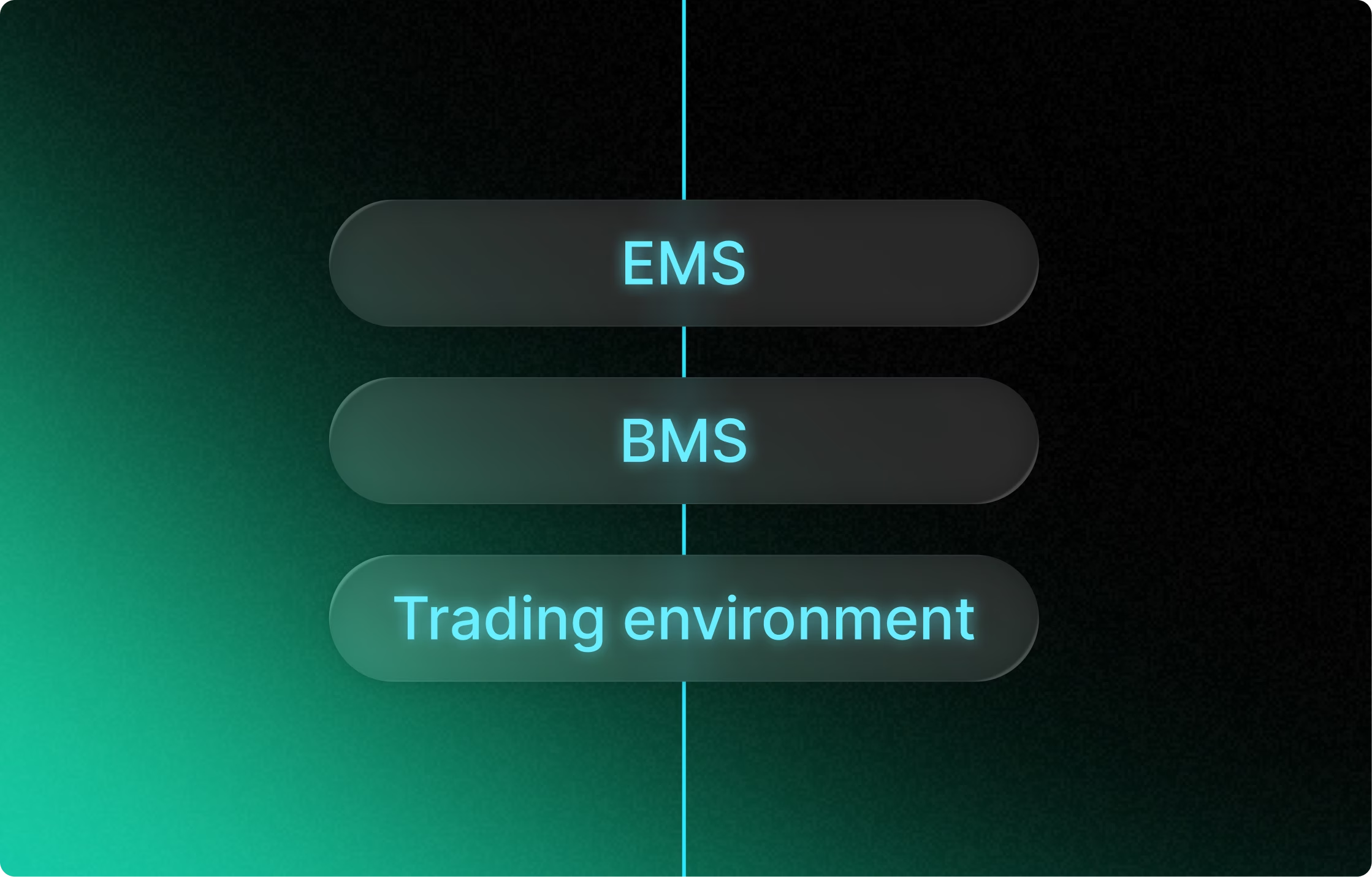
Unlike standalone forecasting models, predictive energy systems are designed to operate inside existing EMS, BMS, BESS, IPP, and trading workflows. Their purpose is not only to predict what may happen, but to support timely operational decisions.
In practical terms, predictive energy systems can support energy cost optimization, imbalance management, battery dispatch optimization, peak load management, renewable production planning, and day-ahead or intraday trading decisions.
Why predictive energy systems need structure
Energy infrastructure is becoming more decentralized, data-intensive, and market-sensitive. The growing share of variable renewable generation, distributed assets, and battery storage has created new requirements for planning and control.
This shift is already visible in Europe. In 2024, wind and solar reached a record 29% of EU electricity generation, while renewables supplied nearly 47% of total EU electricity. As more generation becomes weather-dependent, forecasting becomes a core requirement for planning, balancing, dispatch, and market participation.
Static planning is no longer sufficient for many energy workflows. Operators need forward-looking signals that can support decisions before exposure appears.
A solar forecast that arrives too late cannot support dispatch planning. A load forecast that is disconnected from the BMS cannot support peak demand reduction. A market forecast that updates too slowly cannot support intraday positioning.
This is why predictive energy systems should be designed as operational infrastructure, not as isolated analytics.
A production-grade forecasting layer requires five components: data connection, model configuration, forecast generation, decision output, and production monitoring. Each layer plays a distinct role in moving forecasting from prediction to operational value.
Core forecasting layers in predictive energy systems
1. Data connection
Forecasting quality starts with the signals the system can access.
The data layer defines what the forecasting system can observe, process, and learn from. In energy environments, this layer usually combines historical data, real-time data, weather signals, asset information, and market inputs.
For solar generation forecasting, relevant data may include historical PV production, weather forecasts, irradiance, temperature, cloud cover, asset capacity, inverter data, site-level performance data, curtailment history, and local operating constraints.
For load consumption forecasting, the system may use historical demand, meter readings, building schedules, equipment behavior, weather data, real-time consumption signals, and portfolio-level demand patterns.
For market price forecasting, relevant inputs may include historical electricity prices, day-ahead market data, intraday market data, demand trends, renewable generation signals, grid constraints, volatility indicators, and external market signals.
The goal is not to collect every available data point. The goal is to connect the signals that explain operational variance. A strong data layer should clarify what affects the predicted outcome, which signals are available, how fresh the data is, and whether the data can be trusted at decision time.
Without this layer, a model may produce numbers that appear precise but fail to support decisions under real operating conditions.
2. Model configuration
Model configuration aligns the forecasting system with the asset, market, horizon, and decision workflow.
A generic forecast is rarely sufficient in energy systems. A solar production forecast for a single PV site has different requirements from a portfolio-wide forecast for an IPP. A load forecast for a commercial building has different requirements from a multi-location EMS environment. A day-ahead market price forecast has a different operating rhythm from intraday price forecasting.
The forecasting horizon should match the decision window. Some workflows need a 24-hour view. Others need 48 or 72 hours. Solar generation and load consumption often require forward visibility for planning, while trading workflows may need shorter, more frequent updates.
Update frequency is equally important. Hourly updates may work for planning, while intraday markets, battery dispatch, price alerts, and volatility monitoring may require 30-minute or 15-minute updates.
This requirement is becoming more concrete in European power markets. On 30 September 2025, the EU’s day-ahead electricity market moved from hourly to 15-minute trading intervals, with prices calculated every 15 minutes to reflect expected generation and demand more accurately.
The model should also reflect the asset or portfolio it serves. A building, PV site, BESS asset, and trading desk each has different constraints, commercial risks, and decision cycles. A BESS operator needs forecasting outputs that account for charging windows, price movement, asset utilization, and degradation-sensitive dispatch. A BMS provider needs load forecasts that reflect building-level behavior and demand peaks.
Some decisions can absorb uncertainty. Others require tighter confidence thresholds because the commercial or operational exposure is higher. Model configuration should therefore follow the risk profile of the decision, not only the forecasted variable.
3. Forecast generation
Forecast generation defines what the model produces and how uncertainty is represented.
In energy forecasting, a single expected value is often insufficient. Operators and traders need to understand the range around the forecast because uncertainty affects the decision.
The expected value represents the most likely outcome, such as expected solar generation for a specific site, expected load consumption across a building portfolio, or expected market price for a defined trading interval.
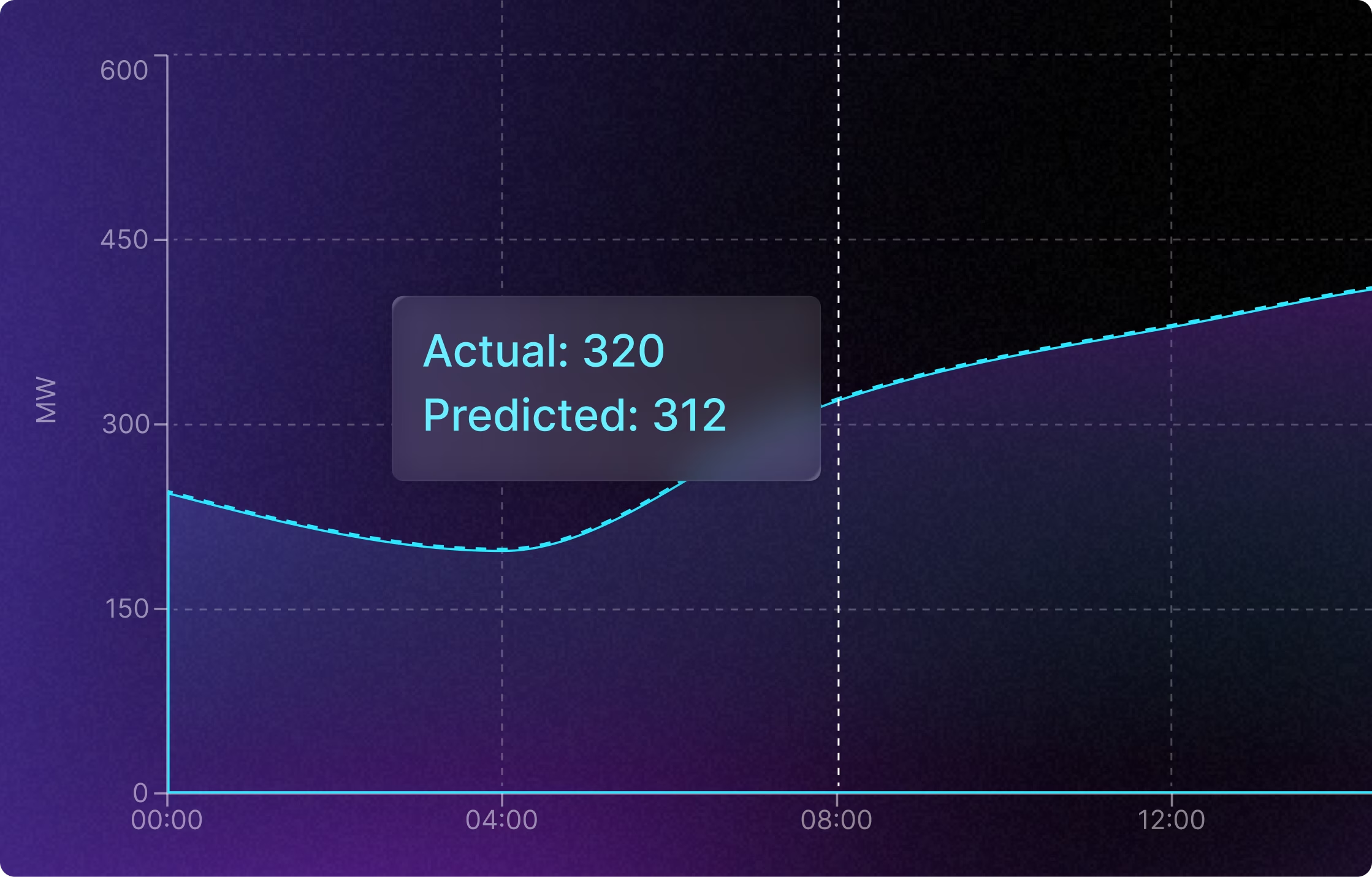
Confidence ranges help users understand forecast uncertainty. Probability outputs such as P10, P50, and P90 can show downside, median, and upside scenarios. This is useful when decisions depend on risk exposure rather than only expected performance.
For example, a solar operator can assess whether production uncertainty is high during unstable weather. A BESS operator can decide whether the expected price spread justifies dispatch. A BMS operator can evaluate whether a potential demand spike requires action. A trader can assess whether a price movement is strong enough to support a position.
Forecasts should also be connected to decision thresholds. These may include production deviation, load spike risk, negative price signals, price spike signals, imbalance exposure, battery dispatch opportunities, data anomalies, or forecast confidence drops.
Thresholds help convert forecasts into operating signals.
4. Decision output
Decision output defines how forecasts are consumed by systems and users.
A forecast should not remain outside the workflow. It should enter the environment where decisions are already made. Different energy environments require different output formats. Some need API outputs, while others need alerts, dashboards, probability reports, or machine-readable signals that feed directly into optimization workflows.
In EMS platforms, predictive energy systems may support energy cost optimization, procurement planning, load balancing, renewable production planning, imbalance management, and portfolio-level optimization.
In BMS environments, forecasts may support peak load management, demand response, energy efficiency planning, building automation, equipment scheduling, and consumption anomaly detection.
For independent power producers, forecasts may support solar production planning, curtailment reduction, scheduling, grid compliance, portfolio reliability, and imbalance exposure reduction.
For BESS operators, forecasts may support charge and discharge timing, arbitrage planning, asset utilization, degradation-sensitive dispatch, price spike response, and renewable smoothing.
For OMIE and EPEX market participants, forecasts may support day-ahead positioning, intraday adjustments, price risk management, bid and offer strategy, negative price preparation, and volatility monitoring.
The key design principle is simple: the format should follow the decision.
5. Production monitoring
Production monitoring ensures that the forecasting layer remains reliable after deployment.
Energy conditions change continuously. Weather patterns shift. Assets degrade. Consumption behavior evolves. Markets respond to regulation, supply, demand, and trading behavior. Forecasting systems must therefore be monitored as live infrastructure.
A production forecasting layer should track forecast accuracy by asset and horizon, forecast deviation by period, data freshness, missing or delayed data, model drift, anomaly frequency, API availability, retraining requirements, and decision impact.
Initial model performance does not guarantee long-term reliability. A model may perform well during validation but degrade when asset behavior, weather patterns, or market conditions change. Monitoring provides the feedback required to detect this shift and trigger retraining or recalibration.
For decision-makers, this is essential. Forecasting should not be evaluated only at deployment. It should be measured continuously against operational and commercial outcomes.
Solar generation forecasting
Solar generation forecasting predicts photovoltaic energy production based on weather forecasts, irradiance, temperature, historical generation, site data, and asset performance signals.
It supports renewable production planning, scheduling, grid compliance, curtailment reduction, imbalance management, portfolio reliability, and trading preparation.
Solar generation is highly sensitive to weather variability and asset-level conditions. This makes forecasting particularly valuable for IPPs, EMS platforms, BESS operators, and market participants.
A useful solar generation forecast should show not only expected production, but also uncertainty ranges and deviation risk. This allows operators to prepare for production shifts before they affect scheduling, balancing, or market exposure.
Load consumption forecasting
Load consumption forecasting predicts future energy demand across buildings, assets, industrial sites, or portfolios.
It supports EMS and BMS workflows such as peak load management, energy procurement planning, demand response, load balancing, building automation, energy cost optimization, and consumption anomaly detection.
Load patterns vary by asset type, operating schedule, weather sensitivity, and user behavior. A commercial building, industrial facility, and distributed property portfolio may each require a different modeling configuration.
For EMS and BMS environments, load consumption forecasting is especially valuable when it can identify demand peaks before they occur. This gives teams time to adjust usage, shift loads, or trigger automation workflows.
Market price forecasting
Market price forecasting predicts electricity price movement across day-ahead and intraday markets.
It supports day-ahead market positioning, intraday market adjustment, bid and offer strategy, procurement timing, battery dispatch optimization, price spike monitoring, negative price preparation, and trading exposure management.
Market price forecasting is highly time-sensitive. A forecast used for day-ahead planning may require a different horizon and update frequency from a forecast used for intraday trading.
For BESS operators, market price forecasting can inform charge and discharge timing. For traders, it can support position review. For IPPs, it can connect production planning with market value.
The value of market price forecasting depends on whether the forecast is available at the right decision interval.
Forecasting requirements for EMS, BMS, BESS, IPP, OMIE, and EPEX workflows
Predictive energy systems should not deliver the same output to every user. The architecture can be shared, but the forecast output should be specific.
EMS platforms need forecasts that support energy cost optimization, procurement, load balancing, and portfolio-level decision-making.
BMS providers need building-level load forecasts that support peak management, automation, and energy efficiency.
IPP companies need solar generation forecasts that support planning, grid compliance, portfolio reliability, and imbalance exposure reduction.
BESS operators need price, load, and generation forecasts that support dispatch, arbitrage, asset utilization, and degradation-sensitive decisions.
OMIE and EPEX market participants need market forecasts that support day-ahead positions, intraday adjustments, price risk management, and volatility monitoring.
This is a critical design principle for predictive energy systems. Forecasting should deliver the right signal to the right workflow.
How to evaluate predictive energy systems
Predictive energy systems should be evaluated across technical, operational, and commercial dimensions.
Technical evaluation should include forecast accuracy, forecast deviation, data latency, update frequency, model drift, API availability, integration reliability, retraining schedule, confidence range quality, and anomaly detection capability.
Operational evaluation should examine whether the forecast is available at decision time, fits existing EMS, BMS, BESS, IPP, or trading workflows, supports alerts and thresholds, works for operational teams, and can be consumed through real-time or batch workflows.
Commercial evaluation should focus on measurable outcomes, such as reduced imbalance penalties, lower energy procurement costs, reduced peak demand costs, higher battery revenue, improved trading margin, reduced curtailment-related losses, improved scheduling and dispatch efficiency, and higher asset utilization.
This evaluation structure ensures that forecasting is assessed not only as a modeling capability, but as a source of operational value.
The question is not only whether the system can forecast. The question is whether the forecast improves the decision.
Common design risks in energy forecasting
Several design risks can limit the value of predictive energy systems.
One frequent risk is starting with the model rather than the decision. A predictive energy system should begin with the decision it needs to support. Model selection should follow the operational requirement.
Another risk is measuring only average accuracy. Average accuracy may hide weak performance during high-impact periods. Energy teams should also evaluate forecast performance during volatile, high-cost, or operationally sensitive intervals.
Uncertainty is another important factor. Energy systems operate under uncertainty, so forecasting outputs should reflect that uncertainty through ranges, probability levels, and thresholds.
Forecasts can also lose value when they remain outside the workflow. If a forecast requires manual transfer, interpretation, or reformatting, its operational use becomes limited. Integration should be designed from the start.
Post-deployment monitoring is equally important. Forecasting performance can degrade over time, so monitoring and retraining are required to maintain reliability.
Finally, the same output should not be used for every user. EMS teams, BMS operators, IPPs, BESS operators, and traders do not need identical forecast outputs. The architecture may be shared, but the output should fit the user’s workflow.
Predictive energy systems should be designed as production infrastructure for modern energy forecasting. They connect data, forecasting models, uncertainty ranges, decision outputs, and monitoring into one operational layer.
For solar generation forecasting, load consumption forecasting, and market price forecasting, value depends on more than model accuracy. It depends on whether the forecasting layer supports decisions inside EMS, BMS, BESS, IPP, and trading workflows.
As energy operations become more volatile and time-sensitive, predictive forecasting will become a core capability for managing cost, imbalance, dispatch, and market exposure.
Forecasting connected to real energy decisions
Forecasting becomes valuable when it is connected to the decisions energy teams already make.
If your team is currently exploring how predictive forecasting could support workflows in solar power generation, load consumption, market pricing, battery deployment, or energy trading, let Nexenergie assist you in determining the right forecasting level for your infrastructure.