'%3e%3cpath%20d='M8.09023%2019.6947H16.349L14.0199%2032.6762H6.6C4.94315%2032.6762%203.60001%2031.333%203.6%2029.6762V6.6C3.6%204.94315%204.94315%203.6%206.6%203.6H20.7152L8.09023%2019.6947ZM31.3119%203.6C32.9687%203.60012%2034.3119%204.94322%2034.3119%206.6V29.6762C34.3119%2031.333%2032.9687%2032.6761%2031.3119%2032.6762H16.9613L31.0521%2014.7123H22.7934L24.7875%203.6H31.3119Z'%20fill='var(--fill-0,%20%232BE6FF)'/%3e%3c/g%3e%3cpath%20id='Vector%20210'%20d='M7.6%2019.6L20.6%203.6H25.1L23.1%2014.1L31.1%2014.6L17.1%2032.6H14.1L16.1%2019.6H7.6Z'%20fill='none'/%3e%3cpath%20id='Subtract_2'%20d='M8.09023%2019.6947H16.349L14.0199%2032.6762H6.6C4.94315%2032.6762%203.60001%2031.333%203.6%2029.6762V6.6C3.6%204.94315%204.94315%203.6%206.6%203.6H20.7152L8.09023%2019.6947ZM31.3119%203.6C32.9687%203.60012%2034.3119%204.94322%2034.3119%206.6V29.6762C34.3119%2031.333%2032.9687%2032.6761%2031.3119%2032.6762H16.9613L31.0521%2014.7123H22.7934L24.7875%203.6H31.3119Z'%20fill='url(%23paint0_linear_274_1147)'/%3e%3c/g%3e%3cdefs%3e%3cfilter%20id='filter0_f_274_1147'%20x='0'%20y='0'%20width='37.9119'%20height='36.2762'%20filterUnits='userSpaceOnUse'%20color-interpolation-filters='sRGB'%3e%3cfeFlood%20flood-opacity='0'%20result='BackgroundImageFix'/%3e%3cfeBlend%20mode='normal'%20in='SourceGraphic'%20in2='BackgroundImageFix'%20result='shape'/%3e%3cfeGaussianBlur%20stdDeviation='1.8'%20result='effect1_foregroundBlur_274_1147'/%3e%3c/filter%3e%3clinearGradient%20id='paint0_linear_274_1147'%20x1='18.956'%20y1='3.6'%20x2='18.956'%20y2='32.6762'%20gradientUnits='userSpaceOnUse'%3e%3cstop%20stop-color='%232BE6FF'/%3e%3cstop%20offset='1'%20stop-color='%231A8A99'/%3e%3c/linearGradient%3e%3c/defs%3e%3c/svg%3e)
Integrating Forecasting into Energy Systems
Forecasting only becomes truly useful when it’s embedded in the systems energy teams already use every day.
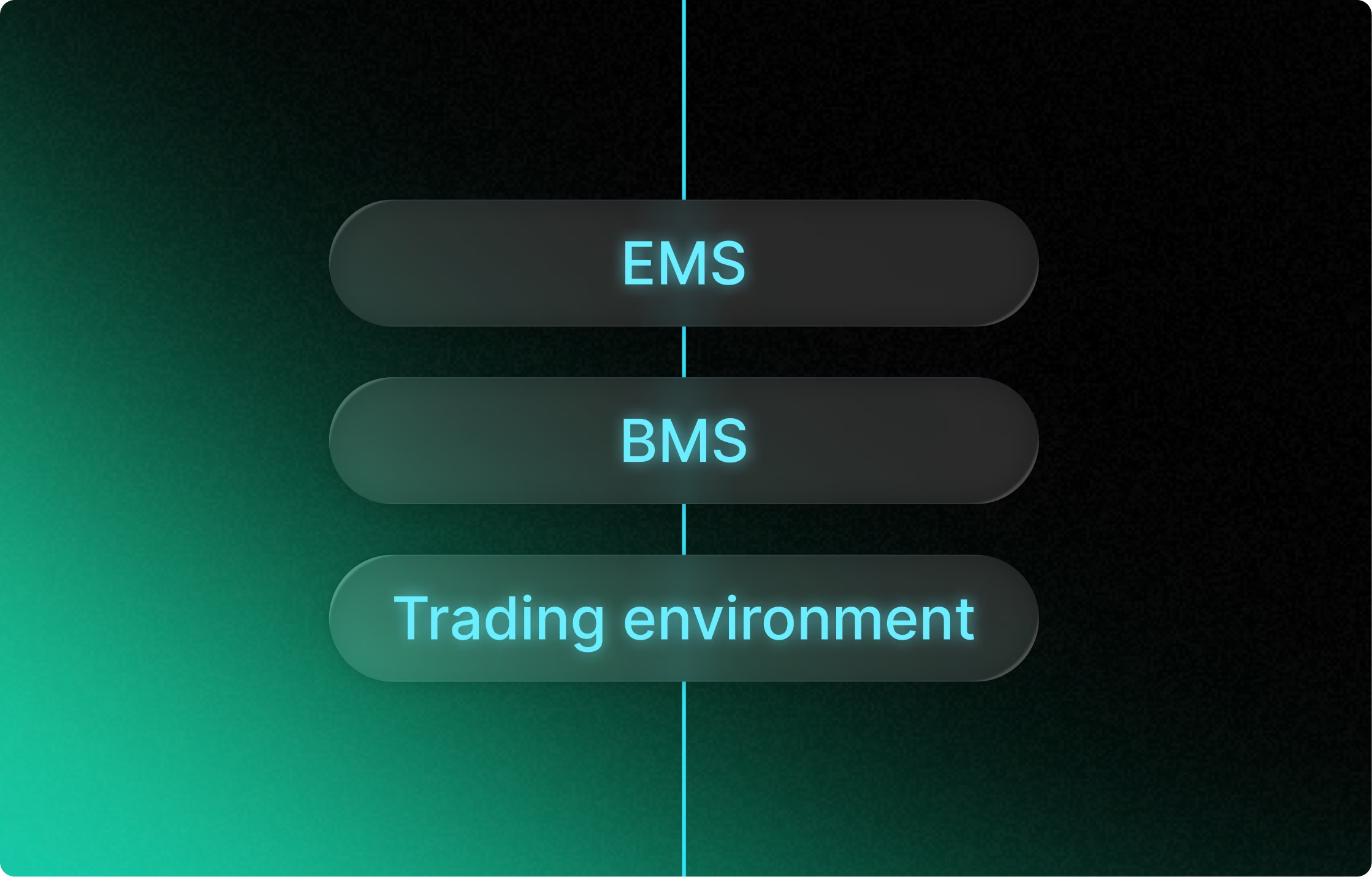
For EMS platforms, BMS environments, and OMIE trading workflows, generating an accurate forecast is only half the battle. The hard part is getting that forecast into the actual decision-making process — in a format that machines can act on, operators can trust, and traders can work with.
A solar forecast sitting in its own dashboard might be nice to look at. But when it feeds directly into the EMS, it can actually drive scheduling, balancing, and dispatch decisions.
A load forecast reviewed once a day can help with planning. Yet when it reaches the BMS in time to catch a rising demand spike, it opens the door to automation and real peak management.
The same goes for market forecasts in OMIE. Interesting is one thing. Useful is when the forecast aligns with trading rhythms and helps with bid adjustments, exposure checks, and intraday moves.
Integration is what separates nice-to-have forecasts from tools teams actually rely on.
Before you pick any forecasting model, ask a simple question: Where exactly will this forecast be used?
Start with the workflow, not the model.
In EMS setups, forecasts might support cost optimization, renewable scheduling, load balancing, imbalance management, or battery dispatch. In BMS environments, they often help with peak shaving, HVAC planning, demand response, or spotting unusual consumption. For OMIE trading, they can inform day-ahead pricing, intraday positions, bid timing, or handling negative prices.
Every workflow has its own pace and logic. Some need human eyes, others need clean API feeds, alerts, or confidence bands. If you ignore this reality, you’ll end up with technically solid forecasts that nobody actually uses.
9 practical patterns for making forecasting work
Pattern 1: Use forecasting as an integration layer
Don’t force teams to rip out their existing EMS, BMS, or trading systems. Those platforms already hold history, permissions, and proven workflows.
Instead, build forecasting as an added layer that pushes smart signals into the tools people already use. This approach creates far less resistance and delivers value much faster.
Pattern 2: Define a clear forecast object
A forecast isn’t just a number. It needs structure — what’s being predicted, for which asset or portfolio, over what time horizon, how often it updates, and how confident we are.
Include context like asset ID, timestamps, creation time, units, and version. Without this, even the best forecast can become unusable noise in the receiving system.
Pattern 3: Start with historical data
Everyone wants real-time forecasts right away. In reality, good integrations almost always begin with historical data. It reveals data gaps, helps set realistic expectations, and lets you test how forecasts would have performed in the past before going live.
Pattern 4: Match update frequency to decision cycles
There’s no universal update speed. A daily planning tool doesn’t need the same rhythm as a battery dispatch system or fast-moving OMIE trading. The goal is simple: update when the workflow actually needs it, not as often as the model can.
Pattern 5: Deliver both machine and human outputs
Systems need clean API feeds. People need clear visuals, alerts, or explanations. The best integrations give both — so automation can run smoothly while operators and traders still understand why something is happening.
Pattern 6: Control noise with thresholds
Forecasts change all the time. Not every change deserves attention. Set sensible thresholds around real risks — imbalance exposure, load peaks, price swings, or confidence drops — so teams aren’t bombarded with alerts.
Pattern 7: Keep decision ownership clear
Decide early who owns the forecast signal. Will it trigger automatic actions, or does it just inform a person? Who reviews it? What needs approval? Clear ownership turns forecasts from background information into part of real operations.
Pattern 8: Validate in the real environment
A great score in a test lab means little if the forecast doesn’t fit actual workflows or timing. Test inside the live EMS, BMS, or trading system and measure what actually matters: better decisions, fewer imbalances, or improved operations.
Pattern 9: Keep monitoring after go-live
Markets shift, buildings behave differently by season, and assets degrade. Continuous monitoring of accuracy, data quality, and business impact is essential. Integration isn’t finished when the connection is made — it’s finished when the forecasts stay useful over time.
EMS integration
EMS platforms juggle many variables at once. Good integration means mapping forecasts carefully to the platform’s asset structure so they support — rather than fight against — existing optimization logic.
BMS integration
In buildings, detail matters. Forecasts need to speak the language of zones, meters, HVAC schedules, and occupancy patterns. Operators want clear signals they can act on, not abstract portfolio-level numbers.
OMIE integration
Trading moves to market time. Forecasts must respect trading intervals and give traders what they need when they need it — whether for day-ahead bids, intraday corrections, or managing risk.
Data governance and traceability
Teams need to know where the forecast came from, which data went in, and how it changed over time. Traceability builds trust and makes it much easier to improve performance when things don’t match reality.
What good integration feels like
It feels natural. No copying numbers between systems. No manual translations. Forecasts simply appear where they’re needed, with enough context for the team to act. When this happens, forecasting stops being a separate tool and becomes part of how the team works.
Integrating forecasting into energy systems is mostly a workflow challenge, not a modeling one. Get the integration right, and forecasts can deliver real value in EMS, BMS, and OMIE environments. Get it wrong, and even the most accurate model will collect dust.
Forecasting should fit the systems already in use
If your team is exploring how forecasting could connect with EMS, BMS, or OMIE trading workflows, it may be useful to review where predictive signals should enter the system, which decisions they should support, and how they should be monitored after deployment.
Nexenergie can help assess how forecasting models could be integrated into existing energy infrastructure with the right data connections, outputs, and workflow alignment.
Explore integration options.